
Every year it happens the same way. The first properly hot week arrives in Lahore, everyone switches on their AC on the same day, and half of them discover it is blowing warm air, dripping on the wall or smelling like a damp cupboard. By then, every AC technician in the city is booked for days.
The fix is simple: get your AC ready before you need it. This guide walks you through a complete pre-summer checklist for split ACs, which are the most common type in Lahore homes. It covers what you can do yourself, what a technician should check, and how to tell whether you need a basic service, a deep clean, a gas top-up or a proper repair.
Short answer: Service your split AC in March or early April, before Lahore's heat peaks and technicians get busy. A proper pre-summer service means cleaning the filters, indoor coil and outdoor unit, flushing the drain pipe, checking gas pressure and the wiring, and testing that the room actually cools. You can wash the filters yourself every couple of weeks; the coil cleaning and gas check need a technician.
Why pre-summer AC service matters in Lahore
Lahore summers are long and hot, and many homes run their ACs for most of the day and night from May onwards. That is a heavy workload for any machine. A few local conditions make maintenance even more important:
- Dust. Dry spring winds, construction and traffic dust settle on filters and outdoor coils. A dirty coil cannot release heat properly, so the AC works harder and cools less.
- Humidity during monsoon. In July and August the AC removes a lot of moisture from the air. If the drain pipe is blocked, that water ends up on your wall or floor.
- Voltage fluctuations and load-shedding. Frequent power cuts and unstable voltage put stress on compressors, capacitors and circuit boards. Loose or burnt wiring is more likely to fail under these conditions.
- Months of sitting idle. After winter, ACs can collect dust, insects and sometimes bird nests in the outdoor unit.
ENERGY STAR, the US government's energy efficiency programme, notes that dirty coils make a cooling system run longer, which increases energy use and shortens the life of the equipment. In a city where ACs run for months, that adds up.
When to schedule your AC service
The best window is usually March to mid-April, before temperatures climb. Technicians are easier to book, you have time to fix any problem they find, and you are not sweating through a breakdown in June.
If you missed that window, do it as soon as you can. A service in May is still far better than no service at all. Many households also do a quick mid-season check in July, when the AC has been running hard and monsoon humidity starts to load the drain.
The DIY checklist: what you can do yourself
Before you start, switch the AC off with the remote and then turn off the breaker or unplug it. Never open the indoor unit while it has power.
1. Wash the filters
Lift the front panel of the indoor unit and slide out the mesh filters. Rinse them under a tap from the back side, use a soft brush if needed, and let them dry completely in the shade before putting them back. ENERGY STAR suggests inspecting and cleaning filters every month during the cooling season; in dusty Lahore summers, every two to four weeks is a sensible habit.
2. Wipe the indoor unit
Wipe the outer cover and the louvres with a damp cloth. Do not spray water directly into the unit, and do not poke at the coil fins behind the filter, because they bend easily.
3. Check the outdoor unit
Look at the outdoor unit on the roof, balcony or wall bracket. Clear leaves, plastic bags, nests or anything blocking the fan or the back grille. Make sure there is space around it for air to flow. If it sits in direct afternoon sun with no gap behind it, mention this to your technician.
4. Look at the drain pipe
Follow the thin drain pipe from the indoor unit to where it ends outside. It should slope downwards all the way, without kinks or dips, and the end should not be buried in dirt or sealed by plaster.
5. Check the remote and settings
Put fresh batteries in the remote. Check that the mode is set to Cool, not Fan or Dry, and that the timer and sleep functions are set the way you want.
6. Do a test run
Once everything is back in place, run the AC on Cool for 20 to 30 minutes. Note whether the air feels clearly cold, whether there is any unusual noise, smell or dripping, and whether the outdoor fan is spinning. These notes will help the technician.
The technician checklist: what a proper service should include
A good AC service is more than a quick spray of water. When a technician comes, you can use this list to understand what is being done and ask questions.
| Check | Why it matters |
|---|---|
| Indoor coil (evaporator) cleaning | Dust and slime on the coil reduce cooling and can cause bad smells. |
| Outdoor coil (condenser) cleaning | A clogged outdoor coil cannot release heat, so the compressor works harder. |
| Blower and fan check | A dirty blower wheel moves less air and can make noise. |
| Drain pipe flush | A blocked drain is the most common cause of water dripping indoors. |
| Gas (refrigerant) pressure check | Low pressure usually points to a leak and causes weak cooling. |
| Electrical connections and capacitor | Loose or burnt wires and weak capacitors are common failures in hot weather. |
| Voltage and current reading | Shows whether the unit is drawing normal power and whether your supply is stable. |
| Temperature drop test | Measures the difference between room air and the air coming out, a simple performance check. |
Ask the technician to show you the coils before and after cleaning, and to tell you the gas pressure reading. A trustworthy technician will be happy to explain what they found.
General service, deep clean, gas top-up or repair: which do you need?
These terms get mixed up, so here is a simple way to think about them.
General service
This is the routine pre-season service: filters, indoor coil, outdoor unit, drain and a basic performance check. If your AC worked fine last summer and was serviced last year, a AC General Service (Split) is usually enough.
Deep cleaning or master service
A deeper clean goes further, often opening the indoor unit more fully so the blower wheel and hidden parts can be cleaned. Consider AC Deep Cleaning & Master Service if:
- the AC has not been cleaned for a year or more,
- it smells musty or sour when it starts,
- you see black spots on the louvres or blower,
- it drips even after the drain has been cleared.
Gas top-up
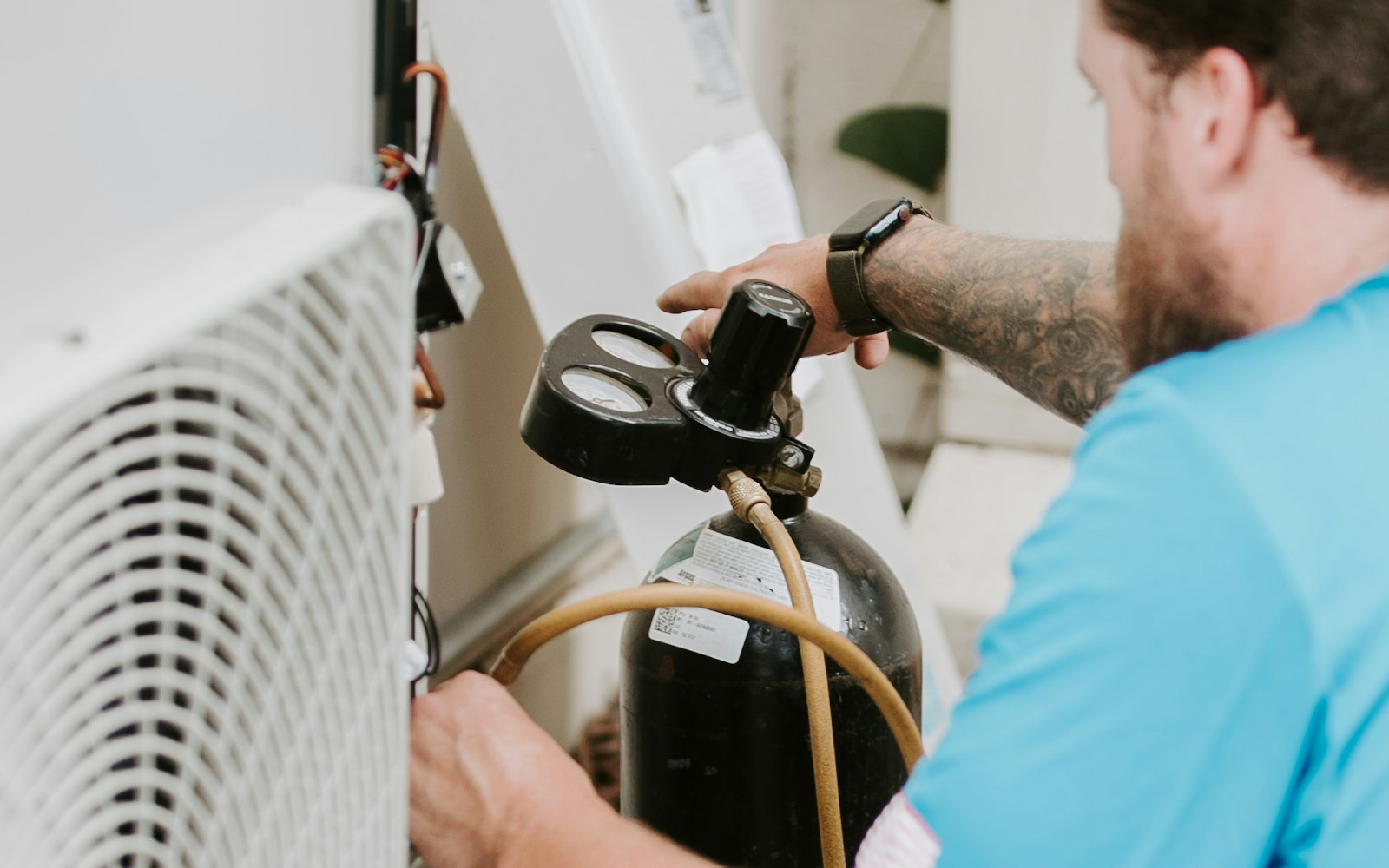
An AC does not use up its refrigerant. If the gas is low, it has leaked out somewhere, often at the pipe joints, flare nuts or a damaged coil. A top-up alone is a short-term fix. Ask the technician to find and seal the leak first, then refill. AC Gas Refill (Top-up) makes sense once the leak has been dealt with, or when you have had a new pipe connection made.
Also make sure the technician uses the same refrigerant type written on your AC's nameplate. Different gases should not be mixed.
Repair inspection
If your AC does not start, trips the breaker, makes a grinding or clicking noise, or the outdoor unit does not run at all, cleaning will not fix it. Book an AC Repair Inspection so a technician can diagnose the fault before any parts are changed.
Warning signs to act on immediately
Switch the AC off and get it checked if you notice any of these:
- A burning smell or any smell of melting plastic
- Sparks, scorch marks or a hot plug or socket
- The breaker tripping every time the AC starts
- Ice forming on the indoor coil or the copper pipes
- Water leaking near electrical points
- Loud banging or grinding from the outdoor unit
Electrical faults in summer are not something to experiment with. If in doubt, keep it off until it has been inspected.
Tips to keep your AC running well all summer
- Keep filters clean. This is the single easiest thing you can do.
- Use a sensible temperature. Setting the AC to its lowest setting does not cool the room faster; it only makes the compressor run longer.
- Close doors and curtains. Keeping out afternoon sun reduces the load on the AC.
- Shade the outdoor unit if possible. A simple shade that does not block airflow can help on exposed rooftops.
- Wait after a power cut. When power returns after load-shedding, give it a few minutes before switching the AC back on, especially if the voltage is unstable. Many modern units have a built-in delay, but older ones may not.
- Protect against low voltage. If your area often has low or fluctuating voltage, ask a technician whether your model needs a stabilizer.
Planning a new AC or moving house?
If you are buying a new split AC or shifting to a new house in DHA, Johar Town, Bahria Town or anywhere else in the city, installation quality matters as much as the brand. Poor installation causes many of the problems people later blame on the AC itself: gas leaks at badly made joints, drain pipes without proper slope, and outdoor units mounted where they cannot breathe.
A proper Split AC Installation should include secure brackets, correctly flared and tightened copper pipe joints, a vacuum or purge before the gas is released, a drain line with a steady downward slope, and a test run with you present.
Frequently asked questions
How often should a split AC be serviced in Lahore?
Most households do one full service before summer and a quick check midway through the season, especially if the AC runs for long hours every day. Filters should be washed far more often, roughly every two to four weeks in peak summer. Homes near busy roads or construction sites may need cleaning more often because of dust.
Does an AC need a gas refill every year?
No. Refrigerant runs in a closed loop and is not used up like fuel. If the gas is low, there is almost always a leak somewhere, so the leak should be found and fixed before topping up. Refilling without fixing the leak usually means paying for gas again soon.
What is the difference between a general service and a deep (master) service?
A general service usually covers washing filters, cleaning the indoor coil and outdoor unit, checking the drain and testing performance. A deep or master service goes further, often removing panels or the blower to clean parts that a normal wash cannot reach. If the AC smells, drips, or has not been cleaned in a long time, a deeper clean is usually worth it.
Why does my AC drip water inside the room?
The most common reason is a blocked or badly sloped drain pipe, often clogged with dust and slime. A very dirty coil or filter can also cause ice to form and later melt and drip. Switch the AC off and have the drain and coil checked, because water can damage walls and wiring.
Should I use a stabilizer with my AC?
It depends on your AC model and the voltage in your area. Many inverter ACs are designed to handle a wider voltage range, while older non-inverter units are more sensitive to low or fluctuating voltage. Check the manual or ask a technician to measure the voltage at your socket before deciding.
Can I clean the AC myself instead of calling a technician?
You can safely wash the filters and wipe the outer cover yourself with the power switched off. Cleaning the coil with pressure, checking gas pressure and opening electrical parts should be left to a trained technician. Doing these yourself can damage the fins, the PCB or your safety.
Get your AC ready before the heat
A little preparation in March or April can save you a hot, frustrating week in June. Wash your filters, look over the outdoor unit, and have a technician clean the coils and check the gas and wiring before the season starts.
If you would like a technician to handle it, you can book an AC General Service (Split) or browse all AC & HVAC services on MrHazir. The current price is shown on each service page, and you can choose a time that suits you.
Photo: Joel Muniz on Unsplash